

The Transfiguration prepares us for the Passover
In the liturgy of the word last Sunday, we read:
The Lord said to Abram, “Leave your country, your family and your Father’s house, for the land I will show you.”
And “Abram went as the Lord told him.”
Where was the land? What is the name of this land? Old Abram was not told. He was simply instructed, “go to a land I will show you.” And he obeyed.
The call was for him the beginning of a journey, the beginning of what the apostle Paul would later describe as walking by faith, not by sight.
Abram left the certitude of his homeland and of his father’s house to begin a journey into incertitude. He began a pilgrimage of faith. And every call is like that. Every vocation is a call to undergo a pilgrimage of faith.
Such was the call of Peter, James and John and the other disciples. One day, as Peter, James and John were fishing, Jesus called them. “Follow me,” he said to them. And they, like Abram, asked no questions. They, like Abram, went as they were told.
Such is our call to the Christian life. Even if we were baptized before the age of reason, even if our parents and the Christian community made the commitment in our name before we attained the age of reason, there comes a time in the life of an adult when one would have to appropriate or repudiate existential decisions taken on one’s behalf at infancy. Such, for example, is the case of the decision to go to school. It was taken on our behalf when we were too little to decide. But there comes a time to choose to continue or to discontinue.
Such is the call to the priesthood, to religious life, to monastic life, or to married life. Like Abram, the Lord calls us to a land he would show us, without giving us any detail about this call, about this land. He gives us no certitude as to where this call is leading us. No certitude except the certitude of faith.
In our relationship with God, we too are called to do as we are told, to venture into the unknown, the uncertain. We are called to walk with God by faith, not by sight. To walk by faith, that is, to walk with confidence in God, confidence that he whose will for us is always good will not abandon us as we undertake this adventure of faith, this adventure that faith is. And in the course of this journey of faith that our Christian vocation is, we shall experience moments of turbulence and moments of darkness, moments when we feel abandoned by God.
Elections are approaching, and Nigerians pray before every election. Yet, on Election Day, we witness fraud and violence. We witness voter intimidation and xenophobia. At the end of every election, we receive results that only a few rejoice about. Sordid tales of irregularities are told. Since the last presidential election, we have been treated, especially on social media, to exchange of insults across ethnic boundaries in a way that makes us wonder: is this a prelude to an inter-ethnic war?
In Nigeria, intense heat of inter-ethnic hatred gives the impression that wounds we thought we had healed when the Nigeria-Biafra war ended 56 years ago are reopened by political actors. Finding a politician who does not play the ethnic card has become a mission impossible. Nigeria seems to be on the way to Kigali, and the vehicle is driven by political gladiators whose supporters fan embers of ethnic bigotry while none of the gladiators assumes the moral obligation of calling their supporters to order.
After the 2023 elections, some began to wonder: if we prayed, why did God allow the whole process to turn out as an embarrassment? Some people have gone as far as saying that if things have not turned out the way we prayed, religion is a scam. No doubt that the faith of many is shaken.
We learn from this that faith is passing through a dark tunnel until we see light at the end of the tunnel. Faith is an invitation to pass through the dark night of the soul as St John of the Cross would describe it in his mystical language. But as we pass through the dark night of Nigerian politics, the Lord himself enlightens us. For he does not abandon us. And that was what happened at the transfiguration.
Jesus took Peter, James and John to a mountain to pray. There his face was transfigured, there his face radiated light and his body radiated beauty. The transfiguration took place to enlighten Peter, James and John in preparation for the dark night of the passion and death of the Messiah. Now the face of Jesus is transfigured, then, in the passion, his face will be disfigured. As the Book of Isaiah would say to us on Good Friday, he would suffer so much that he would no longer look human. He whose human face is now transfigured will then be disfigured by his passion. But the transfiguration would enlighten Peter, James and John so that the darkness of the passion and death of Christ would not make them loose faith in Jesus.
In the illuminating and preparatory experience of the transfiguration, they were instructed about the passion, death and resurrection of Christ. They saw the transfigured face of the Son of God whose face would be disfigured by suffering. In the same way, our Christian vocation is a call to prepare for the way of the cross, the Passover we must undergo before entering into the glory of the resurrection. It is the way Christ Jesus has opened for us, a road all those who have answered his call must travel.
The holy sacrifice of the Mass is for us the new transfiguration. The altar is the mountain of transfiguration. At Mass, we hear and we celebrate the narrative of the passion, death and resurrection of Christ, like Peter, James and John heard about the passion and resurrection of Christ on the mountain of the transfiguration. At Mass, we memorialize the death and resurrection of Christ. At Mass, we encounter Jesus as the Son of God disfigured in suffering and death, and transfigured in his resurrection.
In the holy sacrifice of the Mass, the transfiguration is taking place once again on this mountain, this high place that the altar is. We remember the disfigured Christ who makes himself present as the transfigured and risen Christ in his body and blood.
And so, we pray: may this holy sacrifice enlighten us and prepare us for moments of darkness on our pilgrimage of Christian faith, for our own Passover from this transient life to the unending life of eternity when we shall no longer have to descend from the mountain of the transfiguration, but shall rest in inseparable communion with the risen Christ.
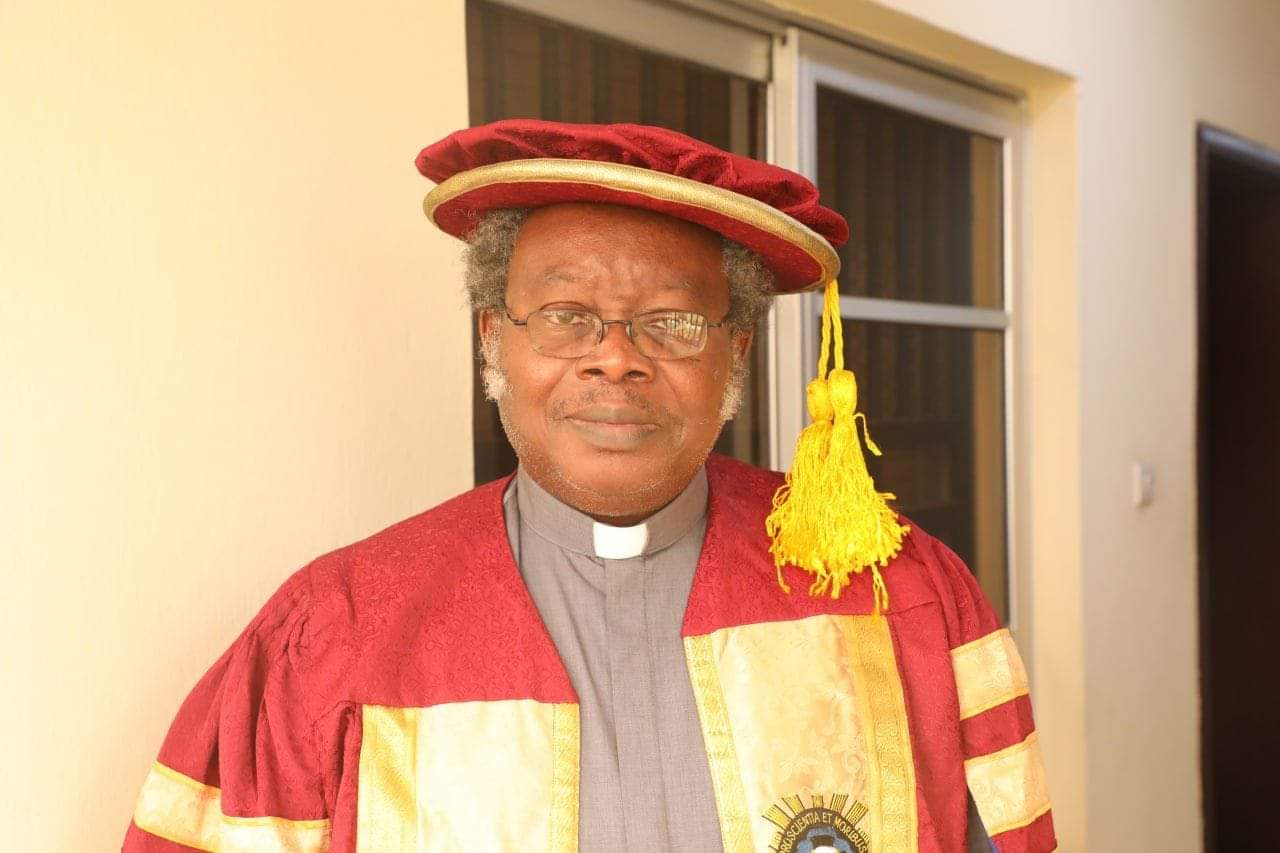
Father Anthony Akinwale, OP


TcqFvLJIihmAMkGuw
neYSNbySozDRTISNJPrZGLP
Mar 15, 2026December 4, 2017 at 09:13