

Trump and Leo
Anthony Akinwale
On May 8, 2025, when American Chicago-born Robert Cardinal Prevost was elected Pope, he chose to be named Leo XIV. The name “Leo” translates into “lion”. A lion is an animal of strength, a ferociously violent creature. But it would appear this Pope does not live by his name.
From the moment he appeared on the balcony of St Peter’s Basilica on the afternoon of his election, Pope Leo XIV has shown that he is not a man of violence. He has been preaching peace. In fact, his first words to the world on that afternoon were: “Brothers and sisters, peace be with you.” It is important to understand the meaning of this greeting.
By way of negation, peace, for Pope Leo, is not the mere absence of war. It is peace inspired by Jesus Christ’s Sermon on the Mount in the Gospel according to Matthew, particularly the Beatitudes, by St Augustine’s writings, and by the tradition of Catholic social teaching.
Concerning the Gospel, one of the Beatitudes in the Sermon on the Mount says, “Blessed are the peacemakers, for they shall be called sons of God.” And, in continuation of that same Sermon, Jesus would say: “Love your enemies, pray for those who persecute you.” But the emphasis on peace in the Sermon on the Mount attracts only very few subscriptions in a world of “delusion of omnipotence”, to use the words of Pope Leo, a world of delusion of military omnipotence.
Concerning the influence of St Augustine, Pope Leo Augustinian. His understanding of peace has been shaped by the intellectual tradition bequeathed by St Augustine, great African philosopher, theologian and bishop in early Christianity. His interventions manifest his familiarity with the huge corpus of St Augustine’s writings in general, and his mastery of Augustine’s magnus opus, City of God in particular.
In City of God, Augustine would speak of peace as tranquility of order (tranquillitas ordinis), and of order as what obtains where there is justice. Peace is therefore the fruit of justice. The tranquility of order that peace is cannot be attained by conquering others but by conquering oneself. It is what obtains wherever and whenever human beings overcome the tendency to love themselves to the point of treating others with contempt. For Augustine, a man is just only to the extent that he controls what he would describe as the libido dominandi—the lust for power exhibited in the lust to dominate others.
Augustine did not totally rule out wars. He in fact formulated the just war theory. According to this theory, a war is just if it is waged for a just cause by a legitimate authority, with justice and peace as its ultimate objective. What Pope Leo has been saying is that the war in Iran spectacularly fails to meet the moral obligations of the just war theory. That failure is compounded when the name of God is evoked to justify the war. For Augustine and for Leo, killing in the name of God, whether it is done by Trump and his Secretary of War or by Boko Haram and Iran, or Hezbollah, is morally reprehensible blasphemy.
Augustine’s notion of justice, to which Pope Leo subscribes, must be presupposed by anyone who desires to understand Augustine’s just war theory. Considering his notion of justice as tranquility of order borne out of love that conquers the self and not other selves, one who would wage a just war in the Augustinian sense must begin by conquering his own self. A just war is waged not by dominating others but by dominating one’s lust for domination. The beginning of a just war is the domination of one’s own desire to dominate others.
What Augustine described as lust for domination is written on the pages of history. History testifies to the prevalence of lust for material possessions underlying lust for domination. Stronger nations conquer weaker ones to dispossess and dominate them. The homeland of Jesus Christ was under Roman domination and indigenous tyranny. The diverse peoples of the African continent found themselves on the receiving end of superpowers. It was the logic of the trans-Atlantic slave trade which was itself made possible by an intra-African slave trade. Trans-Atlantic slave trade provided Europe with cheap labour to facilitate the industrial revolution. This same logic of lust was the driving force of colonialism at a time Europe was in need of cheap raw materials.
Some Christians argue that Pope Leo misreads the Bible when he speaks against wars. They cite examples of the wars Israel fought in the Bible, of David slaying Goliath. But the Pope neither speaks in the name of David, nor in the name of Goliath, but in the name of Jesus Christ. One would have expected Jesus to preach and lead a violent overthrow of Roman domination of his homeland. Instead, he astounded his audience when he preached love of enemies, prayer for persecutors, and peacemaking. That is one reason why Christianity is difficult to practice. But a difficult teaching is not necessarily erroneous. The jubilant crowd that welcomed him into Jerusalem expected a liberator who would conquer the Roman army of occupation by force. But, in jubilation, they missed the symbolism of his entry on the back of a donkey, an animal of peace, not on the back of a horse, an animal on whose back warriors ride.
In times past, Jesus’ teaching on peace made Friedrich Nietzche sneer at him that he was a weakling preaching morality in a world where morality is the legislation of the will of the powerful. Only a weakling would teach you to turn the other cheek when someone slaps you on one cheek. Only a wimp would love and pray for his enemies.
Fast forward to the second decade of the 21st century, to the contrast and confrontation between Pope Leo and President Trump. Pope Leo has unequivocally and repeatedly denounced the war in Iran. President Trump, in his riposte, spoke of Pope Leo in terms similar to Nietzche’s description of Jesus. Nietzche called Jesus a weak man. Trump called Leo “weak” and “terrible”. Trump’s deputy, Vice President J. D. Vance said the Vatican should stick to moral issues. But war is a moral issue.
Vance’s assumption of Machiavellian inspiration that a religious leader should pronounce on morality and not on politics turns out to be erroneous and dangerous. Politics, rightly understood, is a moral issue. Politics is not a set of repeated and related operations with the intention to dominate others. That would be brigandage. Politics, rightly understood, is intelligent regulation of common life for the sake of common good. Common good is the intent of politics. It is a moral project. And in so far as religion shapes morality, Pope Leo has the moral and pastoral obligation to speak on the war in Iran, especially when President Trump threatened to wipe out an entire civilization. When Pope Leo speaks for peace, he is not just addressing his words to Trump. He is speaking also to the Iranians who have an abysmally low record of respect for fundamental human rights, and to all who would use violence to advance their hegemonic ambitions.
On two lighter notes. First, in one of the episodes of Nigerian sitcom, the Village Headmaster, Chief Eleyinmi was insulted while trying to make peace. He reacted to the insult by saying: “Blessed are the peacemakers, for they shall be insulted.” Pope Leo XIV is a peacemaker. He is being insulted.
Secondly, humour sometimes accompanies delusion. That explains why Trump claimed that American Robert Cardinal Prevost would not have been elected Pope if he (Trump) had not been in the White House. If the crowing cock could claim credit for sunrise, the President could claim credit for the election of Pope Leo.
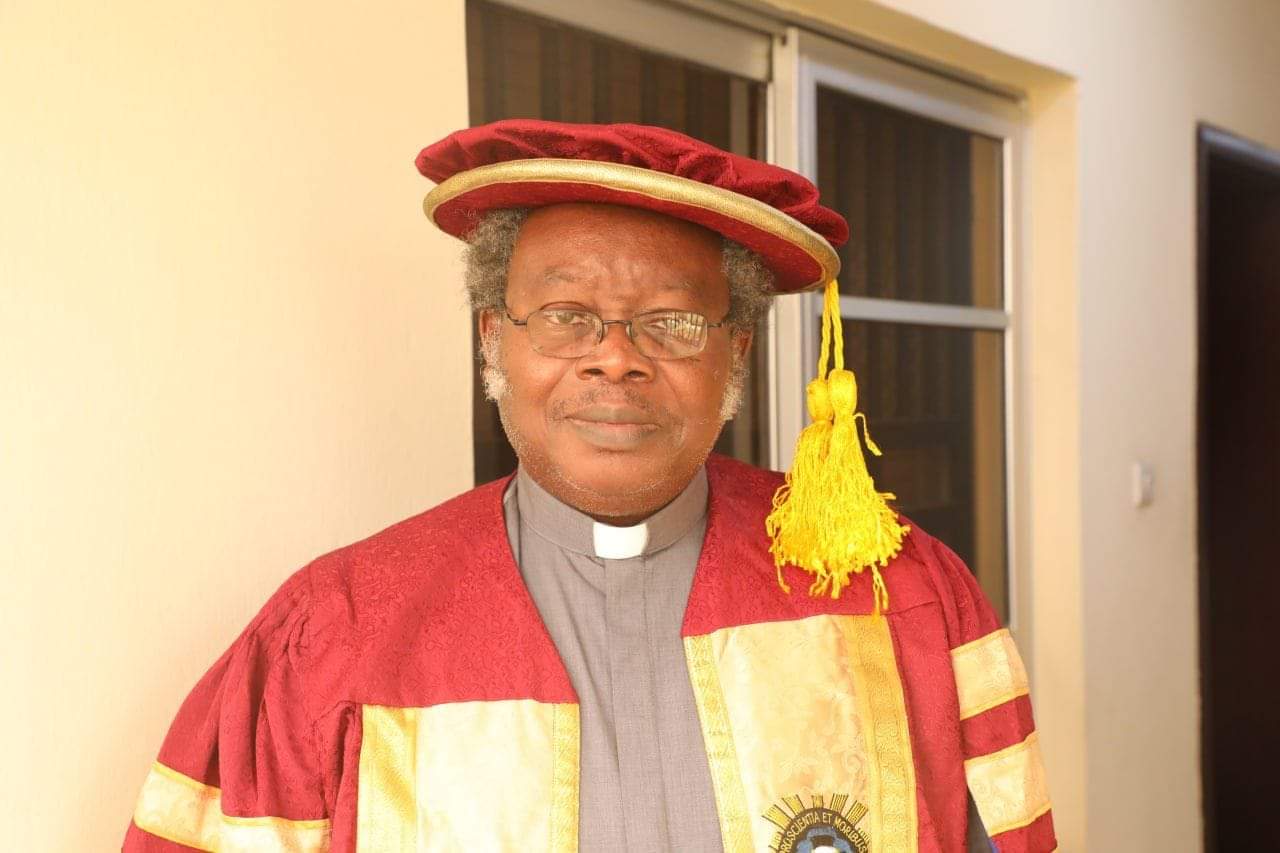
Father Akinwale is Professor at the Department of Philosophy and Religious Studies, Augustine University, Ilara-Epe, Lagos State


Leave a Comment