

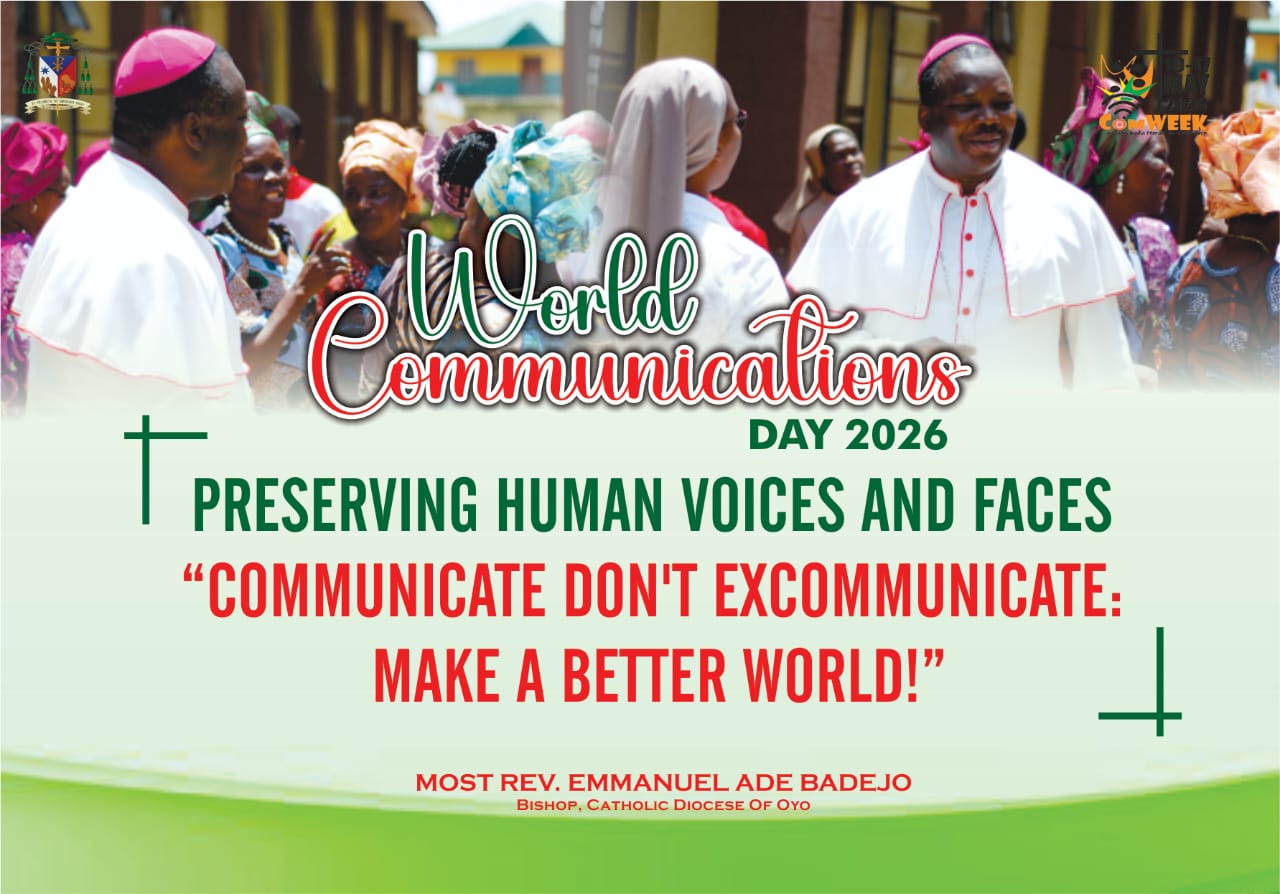
WORLD COMMUNICATIONS DAY 2026
Preserving Human Voices and Faces : Communicate, Not Excommunicate
Reflection of Most Rev Emmanuel Adetoyese Badejo Bishop of Oyo Diocese
The Holy Father Pope Leo focused his first World Communications Day message on the interesting topic: “Preserving Human Voices and Faces. That theme alone demonstrates the Pope’s concern that we should pay attention to the dwindling role of the human face and voice in contemporary communication social relationships. Authentic communication must promote communion with God and with our fellow men and women. Bad communion does the exact opposite causing division, stress and conflict.
A worthwhile Week-long Celebration
As I often like to say we all must aim at communicating without excommunicating - meaning, without alienating others. This World Communication Day celebration is targeted at helping us to balance Faith, Humanity and Digital Presence in our day-to-day relationships and with regards to all. That is why the communications office of the Catholic Secretariat of Nigeria commendably proposed this year as in the past, an incisive and enriching week-long programme for the 2026 celebration.
The aim is to ensure that whenever we engage with the media or with others through the media we must see not to sideline, exclude, demean, hurt or abuse anyone by our communication method and content or by the choices we make? What we do on and with the social media, for example must reflect and represent well the humanity we are part of and also the faith we profess?
We must contend with the ascendancy of the elements of digital media and especially, artificial intelligence today. A lot has been said about how much these gifts of God in our time, wonderful as they are, tend to veil, supplant or even substitute the faces and voices of human beings through whom we get in contact with one another and with God. However, we must do all that is necessary to “save disappearing humanity” from the encroaching “artificialization of communication”
Humans are Irreplaceable
Pope Leo in his message has said: “Faces and Voices are sacred”. We know that sacredness implies being holy, consecrated or being connected to a divine power. Our faces and voices constitute our personality, given to us by God so that we might live our human relationship through love. That is already a very powerful thought to ponder in the economy of relationships in the world today. The Pope writes: “Each of us possesses an irreplaceable and inimitable vocation, that originates from our own lived experience and becomes manifest through interaction with others”. That uniqueness that has defined and cemented human relationship over the ages is now under threat.
The concern is that In this age of artificial intelligence and digital technology, which the Church also embraces, we must safeguard our humanity from the shortage of critical reflection and thinking, the corrosiveness of quick emotional rewards, the consideration of technology as an omniscient friend and the eventual weakening and polarization of the society which would necessarily ensue.
Pope Leo’s insight is so true. One needs only to think about people who today substitute robots for their human companions and relationships These are only little different from those who prefer spending long hours with digital devices and gadgets rather than with fellow human beings from whom they can share warmth, values, compassion and so on. The foregoing has damaged families, friendships and even cooperatives with potential advantage to society.
The fact is that there are far too many people today who simply do not understand the nuances that come with the pleasures of uncritical engagement with digital technologies and artificial intelligence and merely completely entrust themselves to these fascinating tools.
Prayer cannot be Outsourced to Machines
The challenge however does not concern human relations alone but also human relationship with God. In teaching about prayer, Jesus taught that the more personal our relationship with God is, the more effective our prayer becomes. “Truly, truly, I say to you, if you ask anything of the Father, he will give it to you in my name” (Jn 16: 23). Therefore, if we want to be in touch with God we have to pray and pray well, by asking for our needs in His name – that is a personal process. It is only through such prayer that we can best speak to God and God can speak to us in love. A good sample of this great prayer of Jesus for unity which we read in today’s gospel (Jn 17: 1-11)
Just imagine for one minute anyone communicating with God by his cell phone or television! We are therefore called to strive to see the face of God in every human being and hear His voice in the voice of every one we meet. Faces and voices reveal every human being’s unrepeatable identity. The inordinate and ubiquitous use of the media gadgets of today impede our full appreciation of each other’s value and of God’s transcendence in this regard.
The Imperative of Digital Media Education
The way out is certainly not to demonize the digital media but to educate ourselves more to critically engage with and profit from the resources they offer through media and information literacy. As the Holy Father rightly emphasized, we all need to cherish the gift of communication as the deepest truth of humanity, to which all technological innovation should also be oriented. Only thus can human voices and faces be preserved in our society to ensure the re-humanization of our world which in many ways is so dehumanized.


Leave a Comment