

THE MAN, FRANCIS OF ASSISI
Friar Patrick Ikpi, OFM Cap.
As the global Catholic community enters the year 2026, the eyes of the faithful are turned toward St Francis of Assisi. By the decree of the Holy Father, Pope Leo XIV, the Universal Church sets this year as the Franciscan Jubilee Year. The Pope officially opened the YEAR OF ST FRANCIS on January 10, 2026, to commemorate the 800th anniversary of the death of St. Francis of Assisi (3rd October 1226-2026). In this Jubilee year of St Francis of Assisi, the Pope invites all Christians worldwide to rediscover St Francis’ message of peace, fraternity, and reconciliation. The celebration emphasizes living the Gospel through simplicity, humility, and care of creation.
But then, who was "The Man Francis?"
Born in Assisi, Central Italy, in 1182, to Pietro Bernadone and Dame Pica. Francis was initially named John (after John the Baptist) by his mother in the absence of his father. When his father, Pietro Bernadone, returned and learned of this name, he became angry, holding that the name John suggests poverty, fasting, desert, isolation, and values diametrically opposed to his own philosophy of life. Therefore, the child had to be renamed. Influenced by his business dealings in France and his admiration for French culture, Pietro renamed him Francesco, meaning “little Frenchman,” a name associated with gracefulness, wealth, and poetry.
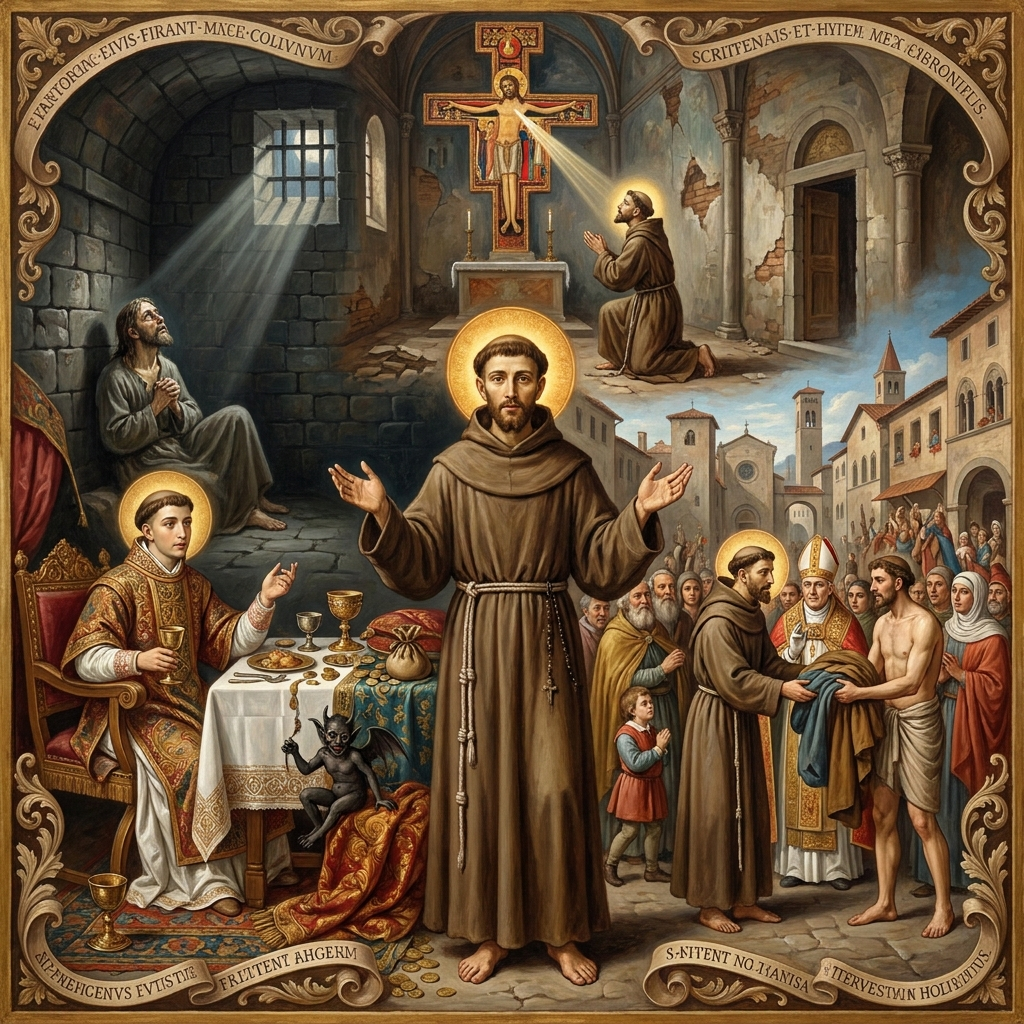
Francis was the son of a wealthy silk merchant. He did not grow up in poverty, but lived comfortably, spending his father’s money on lavish banquets and dreaming of becoming a great and noble knight. He was a man of the world, chasing dreams of success and recognition. Few could have imagined that this cheerful son of a wealthy merchant would one day renounce wealth completely, embrace a life of poverty and simplicity, and become one of the most beloved saints in Christian history.
In 1202, during a bloody war between the cities of Assisi and Perugia, Francis was captured and imprisoned in a dark, damp dungeon for a year. After being taken as a prisoner of war and suffering a prolonged illness, God met him in his brokenness. Francis realized that the "palaces" of this world were empty. His conversion wasn't just a religious change; it was a total human transformation. The harsh conditions of captivity, combined with illness and suffering, deeply changed him. This experience became the beginning of his spiritual transformation, leading him away from wealth and pride toward a life devoted to God.
The historical turning point in the life of Francis occurred at the crumbling Church of San Damiano. While praying before a Byzantine crucifix, the 25-year-old Francis heard a voice saying: "Francis, go and repair my house, which is falling into ruin." Initially, he took this command literally by selling his father’s cloth to buy bricks to rebuild the Church. This led to a famous historical trial before the Bishop of Assisi, after his father reported Francis to him for selling his clothes. Francis then stripped off his fine clothes, handed them back to his father, and declared, "From now on, I will not say 'Father Pietro di Bernardone,' but 'Our Father who art in heaven.'" When he stripped naked in the public square of Assisi, giving his expensive clothes back to his father, he wasn't just being dramatic; he was declaring that his only identity was "Francis, a child of God. Through this act, Francis renounced his father’s wealth to dedicate himself completely to God and to a life of poverty and simplicity, in opposition to material acquisitions and possessions.
The "Man Francis" finally found his specific calling on February 24, 1208, at the Portiuncula. During Mass, he heard the Gospel of Matthew (10:7–10), where Jesus sends out the disciples: “Take no gold, nor silver... no bag for your journey, nor two tunics, nor sandals, nor a staff.” Francis exclaimed, "This is what I wish; this is what I seek; this is what I long to do with all my heart!" His simple way of life attracted men and women of all ages, married and single. He became a model, a rule, and a way of life for all of them. Three different Orders eventually arose: a First Order (comprising the Friars Minor, Conventuals, and Capuchins), a Second Order (Poor Clares), and a Third Order, originally for those bound by either marriage or office. Today, a vast number of people live either as religious under the Franciscan Rule or as members of the Secular Franciscan Order.
Near the end of his life, while praying on Mount La Verna, Francis received the stigmata, becoming the first recorded saint to bear stigmata. St. Francis of Assisi died on October 3rd, 1226, after a prolonged illness. He chose to lie on the bare ground as a final sign of humility and poverty. His peaceful death reflected the simple and holy life he had embraced.
The life of St. Francis of Assisi continues to shine as a model of simplicity. Even after eight centuries, his message still speaks to a world troubled by greed, conflict, and spiritual emptiness. In his proclamation of this Franciscan Year, Pope Leo XIV has noted that the history of Francis is a "prophecy for the 21st century." If Francis could abandon everything to find true joy, what prevents us today from seeking a life of simplicity?


Leave a Comment