

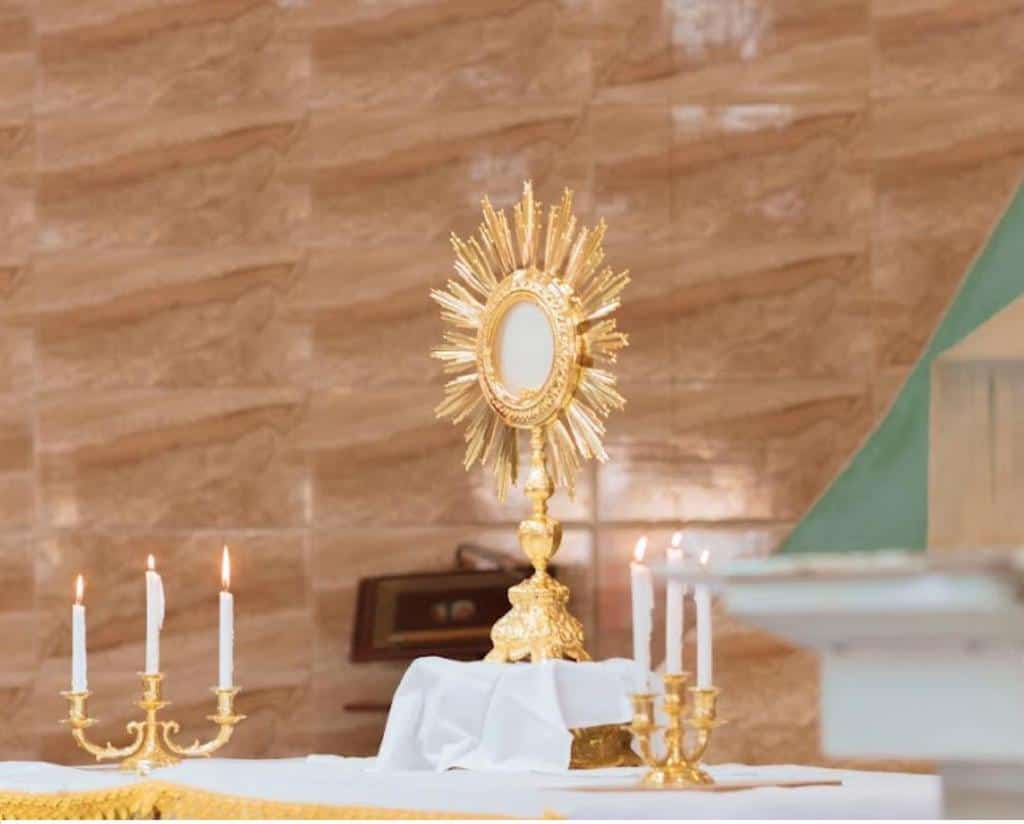
A Privileged Happy People.
Prof Wale OLAJIDE, RHC.
St. James, Northampton. United Kingdom.
There was a time, not many years ago at the celebration of the Holy Mass when it was time for Holy Communion, the altar servers, two of them, will meet at the centre, make a bow and make for the altar rails flip back the white cloth covering them towards the congregation. The rails come with kneelers. The altar servers then return to their positions after making another bow. A line is building by the people ready to receive Holy Communion. They bow in front of the altar and kneel at the rails the fingers of both hands prayerfully locked under the white rail cloth waiting for the priest to distribute and they to receive the Body of Christ the chance to receive the Blood of Christ those days was rare. That done, they all solemnly file back to their respective seats in prayer. That was some time ago.
Today, the communion rails may or may not be there at all and if they are, they merely help demarcate and separate the altar from the rest of the Church. You can still find places to kneel though either consisting sometimes of concrete steps or cushioned kneelers and where neither exist, people stand to receive Holy Communion. The white rail cloth is gone vanished.
There was a teaching that time which goes with all that I have tried to described above albeit with some nostalgia. As baptized Catholics preparing for Holy Communion then, we were taught that at the words of consecration by the priest both the bread and wine on the altar change to the actual Body and Blood of our Lord Jesus Christ. We were warned never to bite into the host received. You simply leave it on your tongue until it dissolves and you swallow. To drum this warning home, the graphic story is ceaselessly repeated by priests and unsmiling catechists about that priest who doubted the solemn truth and fact of transubstantiation, the actual turning of bread and wine into the Body and Blood of Jesus and the altar on which he was presiding was at once covered in blood.
Imagine mistakenly biting into the host received accompanied with just a little doubt and you are covered all over in blood. This story and the fear of violation of the prohibition did the trick and no one dared chew what was received. Today, the prohibition is no longer taught or mentioned for some preferred reason, the fear has equally somehow disappeared and there is great chewing going on.
This mystery of the truth of transubstantiation that Christ is present whole and entire in each of the species whole and entire in each part which of course makes the Holy Mass the greatest prayer attesting to the essence of our faith and undoubtedly the sacrificial truth of our salvation as Christians may just be blipping. But why make this observation?
At the recent Corpus Christi celebration Mass the homily expectedly stressed the need today, more than ever before, to revisit the true meaning of the Holy Communion the sacrament which unites us to Christ and makes us sharers in the Body and Blood to form a single body, the mystery which surpassing human understanding by the invocation of the Holy Spirit turns the bread and wine into the Body and Blood of Jesus Christ and to fully understand and appreciate the fact that at communion it is the actual Body and Blood of Christ that we receive. That we should in the spirit of cognitive renaissance approach the reception with awe and gratefulness that Christ now lives inside of us as Emmanuel and our Saviour. That within us He blesses protects and abides with us. That we can talk intimately and directly with Him as we affirm the truth of His resurrection. That with communion Christ is above us always to bless us behind us to guard and protect us and before us to lead us.
This solemnity then with the mystery and holiness that accompanies it perhaps needs today to be revisited and retaught given the noticeable shortfall on conscious mindfulness that is characterised by disturbing patterns of irreverence particularly among the youth. This little piece becomes then a call for a reawakening catechesis from those that are equipped to teach it a plea for appropriate spiritual enlightenment.


Leave a Comment