

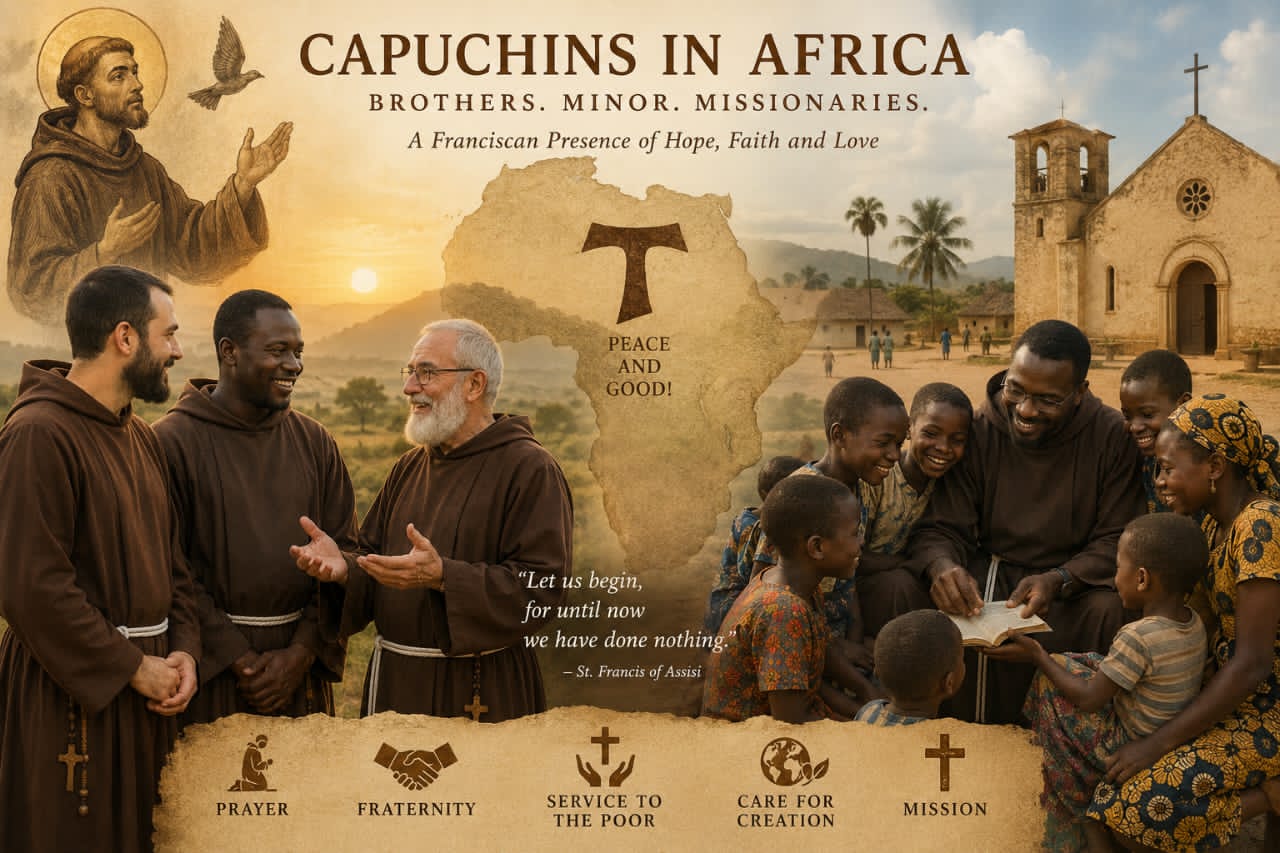
Who Are the Capuchins? History and Presence in Africa
JUBILEE YEAR OF SAINT FRANCIS OF ASSISI
Friar Francis Echezona UZOECHI OFMCap
The Order of Friars Minor Capuchin (OFM Cap.) is one of the three branches of the First Order of St Francis, together with the Friars Minor (OFM) and the Friars Minor Conventual (OFM Conv.). The Capuchins belong to the same Franciscan First Order and profess the Rule of St Francis, approved by Pope Honorius III in 1223. What distinguishes the Capuchins is their particular reform and tradition within the Franciscan family, characterised by a strong emphasis on prayer, fraternity, poverty, simplicity, minority, and closeness to the poor.
The Capuchin reform emerged in the sixteenth century as a movement of renewal within the Franciscan Observant tradition. Several friars desired a more rigorous observance of the Rule and a return to the simplicity, poverty, prayer, and penitential spirit associated with the earliest followers of St Francis. Before the emergence of the Capuchin reform, tensions had already arisen within the Observant movement between different interpretations of Franciscan observance, particularly among groups commonly described as the Spirituals and the Community.
The Capuchin reform began with Matthew of Bascio, an Observant Franciscan friar. Matthew did not initially intend to establish a new religious Order. Rather, he desired permission to live the Rule of St Francis more literally and to return to the simplicity of the primitive Franciscan life. His desire was shared by other friars, particularly Louis of Fossombrone and Raphael of Fossombrone. The movement developed when Louis of Fossombrone petitioned Pope Clement VII for permission for the friars to live a more eremitical life according to the Rule of St Francis, to wear a habit with a long hood, to grow beards, and to preach among the people. After some hesitation, Pope Clement VII approved the new reform through the papal bull Religionis Zelus, issued on 3 July 1528. This approval marked the formal beginning of the Capuchin reform.
The early Capuchins were initially known as the Friars Minor of the Eremitical Life, reflecting their emphasis on solitude, prayer, and contemplation. They later became known as Capuchins because of the distinctive shape of the hood of their habit, from the Italian word cappuccio, meaning hood. Although the early friars placed a strong emphasis on contemplation and solitude, they gradually became deeply involved in apostolic ministry. They became particularly known for preaching, hearing confessions, caring for the sick and dying, serving the poor, and accompanying people in times of difficulty. Thus, the Capuchin vocation developed around a harmonious union of contemplation and apostolic service.
The missionary dimension of the Capuchin vocation eventually carried the friars beyond Europe. Africa became one of the important fields of Capuchin missionary activity. Today, the Capuchin Order has a presence in many parts of Africa, spanning West, Central, East and Southern Africa, as well as the islands of the Indian Ocean. The African Capuchin presence includes countries such as Benin, Burkina Faso, Cape Verde, Côte d'Ivoire, Ghana, Nigeria, the Democratic Republic of the Congo, Cameroon, Chad, the Central African Republic, Gabon, Kenya, Tanzania, Uganda, Ethiopia, Eritrea, Sudan, Zambia, Zimbabwe, Malawi, South Africa, Mozambique, Angola, Madagascar and Seychelles. Administratively, the Capuchins of Africa are organised principally into two continental conferences: the Conference of Capuchins of West Africa (CONCAO) and the Eastern Africa Capuchin Conference (EACC).
Capuchin in Nigeria
The modern history of the Capuchins in Nigeria began in a remarkable way through the vocation of a young Nigerian, Akosa Emodi.
In 1979, while studying in the United States of America, Akosa Emodi was inspired by the life of St Pio of Pietrelcina and became attracted to the evangelical life of the Capuchin Franciscan Order. He joined the Mid-America Province of the Capuchins. During his novitiate, however, he developed a strong desire to return to Nigeria and establish the Capuchin way of life in his homeland. Rather than simply remaining in the United States, he returned to Nigeria to seek the possibility of having the Capuchins officially invited to the country. He approached the then Archbishop of Onitsha, Most Rev. Francis Arinze, who later became a Cardinal, and shared with him his desire to establish the Capuchin presence in Nigeria. After a period of prayer and discernment, Archbishop Arinze formally invited the Capuchins to his Archdiocese in a letter dated 20 August 1982. The Tuscan Province of the Capuchin Order accepted the mission of establishing the Order in Nigeria.
On 12 March 1984, Br. Giulio Galassi, OFM Cap., arrived in Nigeria and became the first Capuchin missionary in the modern foundation. On 12 May 1984, he was joined by Br. Bernardino Faralli and Br. Mario Folli. Their arrival marked a new chapter in the history of the Capuchin Order in Nigeria. The friars were initially accommodated at St Mary's Parish in Onitsha. On 16 January 1985, they moved to the site of their permanent friary at Three-Three Junction, Nkwelle-Ezunaka, near Onitsha. The construction of the friary was completed around 1990, and the new friary was blessed and inaugurated on 13 September 1990. It was subsequently established as a house of novitiate and became an important centre of formation for the growing Capuchin presence in Nigeria. The establishment of the Capuchin presence in Nigeria soon developed into more than a missionary foundation. The Order began to cultivate indigenous vocations and establish the different stages of initial formation within the country.
In the earliest years, some stages of formation were undertaken in the Tuscan Province in Italy. However, from 1989, the stages of initial formation began to be carried out in Nigeria. This was an important development because it allowed young Nigerian men who were discerning the Capuchin vocation to receive their formation within their own cultural and ecclesial context while remaining faithful to the universal Capuchin tradition.
The development of formation houses became one of the most significant aspects of the growth of the Order in Nigeria. The friaries at Onitsha, Enugu, Ibadan and Benin subsequently played important roles in the formation of the friars through postulants, novices, students of philosophy and theology.
The Capuchin Apostolate in Africa Today
The Capuchins in Africa are engaged in a wide variety of ministries. These include parish ministry, evangelisation, preaching, sacramental ministry, spiritual direction, religious formation, education, youth ministry, care for the poor, social development, healthcare and missionary outreach, etc. Another important area is Justice, Peace and Integrity of Creation (JPIC). The Order has been strengthening its JPIC mission across the African continent, with particular attention to formation, social responsibility, peacebuilding, human dignity and care for creation. In 2026, the Order organised a continental JPIC formation programme for African formators in Addis Ababa.
Finally, this Jubilee year calls the Capuchins in Africa to remember their history with gratitude, return to the Gospel and the spirit of St Francis, renew fraternity and service to the poor, and courageously embrace their missionary responsibility for the future of the Church and Africa.


Leave a Comment