

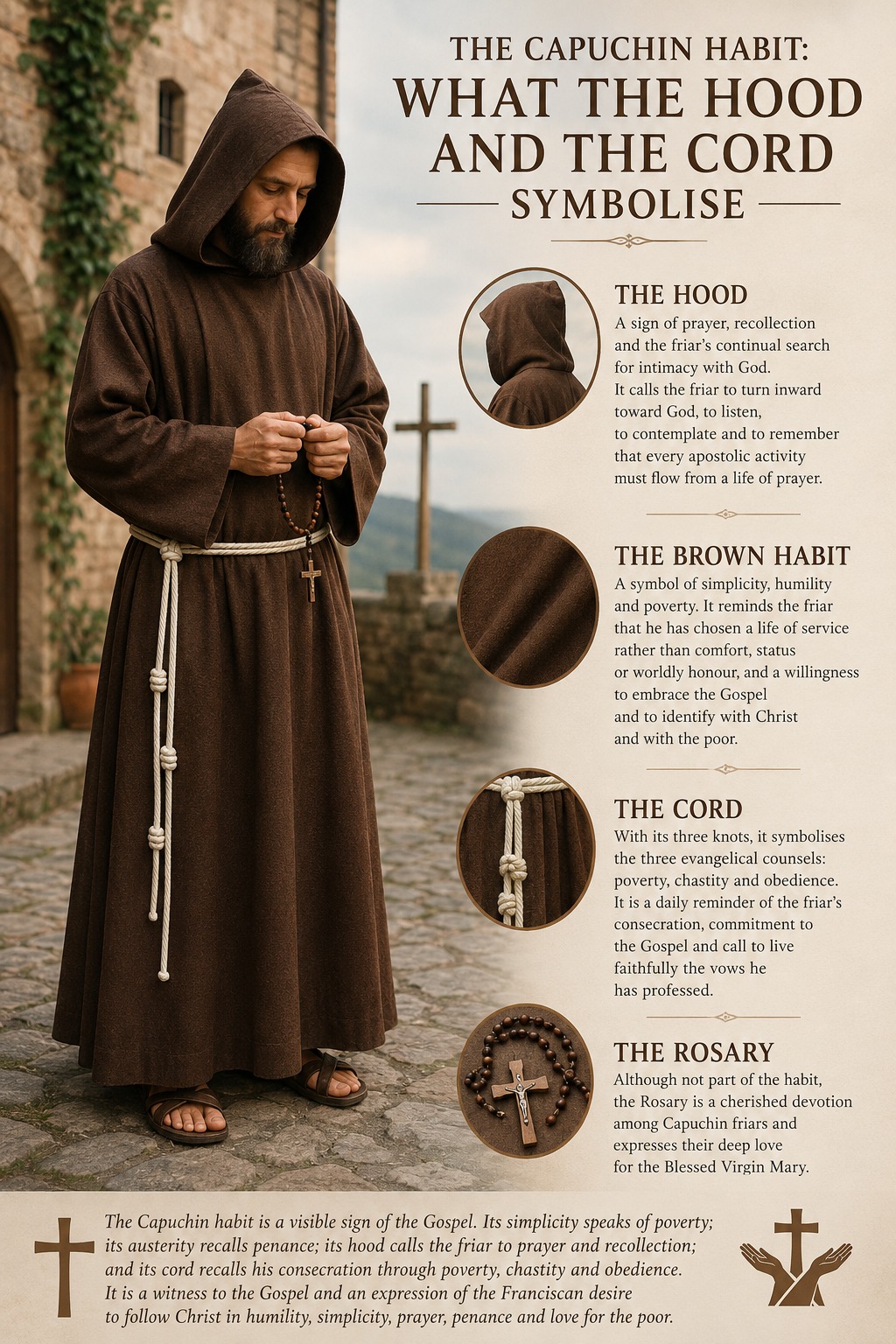
THE CAPUCHIN HABIT: WHAT THE HOOD AND THE CORD SYMBOLISE
JUBILEE YEAR OF SAINT FRANCIS OF ASSISI
Friar Amos Peter TYONGI OFMCap
The Capuchin (Franciscan) habit is more than a simple garment. It is a visible expression of the spirituality, vocation and mission of the Capuchin friar. Rooted in the habit of St. Francis of Assisi and developed within the Franciscan tradition, the Capuchin habit reminds those who wear it of their call to follow Christ in humility, poverty, prayer, penance, and service. The Capuchin habit consists principally of a brown or chestnut-coloured tunic with a hood, a cord around the waist, and sandals or shoes for a good reason. Although the Rosary is not formally part of the habit, it is a common devotional object among Capuchin friars and reflects the Order's strong devotion to the Blessed Virgin Mary. Though simple in appearance, each element carries a spiritual significance rooted in the Franciscan tradition.
The spirituality of the habit is closely connected with the Cross of Christ. St. Francis had a profound love for Christ crucified and spent much of his life contemplating the mystery of Christ's passion. His devotion became so profound that, at La Verna in 1224, he received the stigmata, the wounds of Christ, traditionally regarded as the first recorded instance of the stigmata in the history of the Church. His life and example continue to inspire the entire Franciscan family.
The brown colour of the habit is traditionally associated with simplicity, humility and poverty. Franciscan tradition also presents St Francis as embracing humility and identifying himself with the lowliness of the earth, which is trodden upon. It reflects the Capuchins’ desire to live without attachment to worldly wealth and to remain close to the poor and the marginalized. St. Francis sought to imitate Christ, who chose a life of humility and simplicity. The simplicity of the habit reminds the friar that he has chosen a life of service rather than comfort, status or worldly honour. It is a visible sign of his willingness to embrace the Gospel with simplicity and to identify himself with Christ and with those who are poor. For this reason, the Franciscan habit has traditionally been understood as a garment of penance. It reminds the friar that following Christ requires conversion of heart, denial of self, and willingness to carry the Cross.
One of the most distinctive features of the Capuchin habit is the hood. Indeed, it is from the Italian word cappuccio, meaning “hood”, that the name Capuchin derives. Beyond its distinctive appearance, the hood can be understood spiritually as a reminder of prayer, recollection, and the friar’s continual search for intimacy with God. Franciscan spirituality places great importance on moments of solitude and recollection, in which the friar withdraws from distractions in order to encounter God in silence and contemplation. St. Francis himself frequently sought solitary places where he prayed and contemplated the love of God. For the friar, the hood can therefore serve as a reminder that, even while engaged in preaching, pastoral ministry, and service to others, he must remain rooted in prayer and united with God. Thus, the hood has been seen as a call to turn inward toward God, to listen, to contemplate and to remember that every apostolic activity must flow from a life of prayer.
In the same vein, another important part of the Capuchin habit is the cord tied around the waist. Traditionally, the Franciscan cord has three knots, which symbolize the three evangelical counsels of poverty, chastity and obedience. These counsels form an essential part of consecrated religious life. Through poverty, the friar seeks freedom from excessive attachment to material possessions and places his trust in God. Through chastity, he offers his whole life to God and seeks to love others with an undivided heart. Through obedience, he freely places his will at the service of God, the Church, and the community. The cord represents more than something that holds the habit together. It is a daily reminder of the friar's consecration, his commitment to the Gospel, and his call to live faithfully the vows he has professed.
Simply put, the Capuchin habit does more than identify a religious order. It silently preaches the Gospel. Its simplicity speaks of poverty; its austerity recalls penance; its hood calls the friar to prayer and recollection; and its cord recalls his consecration through poverty, chastity, and obedience.
In a world where wealth, fame, comfort, and power can easily become measures of success, the Capuchin habit offers a different message. It reminds both the friar and those who encounter him that true greatness is found not in possessing more, but in giving oneself more completely to God and to others. The habit is therefore a reminder of the Cross, a witness to the Gospel and an expression of the Franciscan desire to follow Christ in humility, simplicity, prayer, penance and love for the poor.


Leave a Comment