

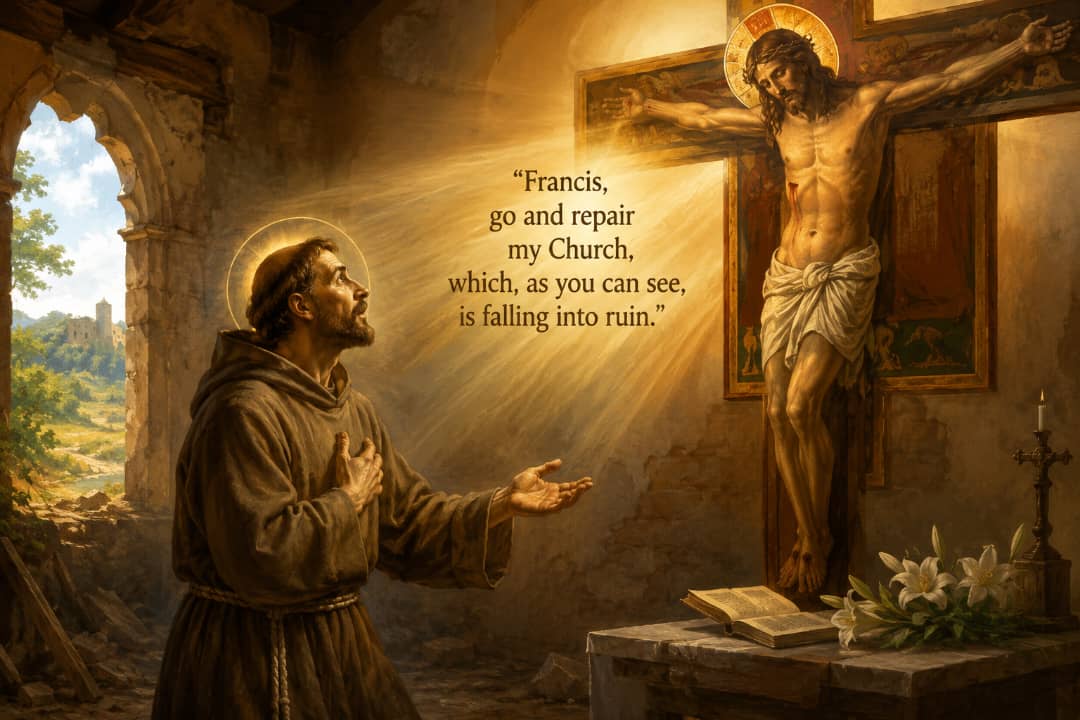
THE VOICE AT SAN DAMIANO: FRANCIS "GO AND REPAIR MY CHURCH": AN IMPERATIVE FOR ALL CHRISTIANS
JUBILEE YEAR OF ST. FRANCIS OF ASSISI
Friar Raphael U. OCHEI OFM Cap.
The history of Christianity contains moments that reshape not only individual lives but also the life of the Church itself. One such moment occurred in the life of Saint Francis of Assisi when he prayed before the crucifix in the small Chapel of San Damiano. San Damiano was a small, old, and neglected Chapel situated outside the town of Assisi. Time and neglect had left the structure physically damaged and abandoned. However, this ruined and forgotten place would become the setting of a divine encounter that transformed Francis’ life and eventually contributed to the renewal of the Church in his time.
Before this experience, Francis himself was undergoing a profound inner struggle. After being taken prisoner during a war and suffering a prolonged illness, he encountered God in the midst of his brokenness. This experience marked the beginning of his spiritual transformation, leading him away from a life of wealth and pride towards a life devoted to God. The material possessions that had once brought him joy no longer satisfied him. Francis found himself searching for something deeper and more lasting. This internal conflict marked the beginning of his journey of conversion and prepared his heart for a new encounter with God.
During this period of spiritual uncertainty, Francis often sought solitude and prayer. One day, while praying before the crucifix in the Chapel of San Damiano, he experienced an extraordinary encounter. From the crucifix, he heard the voice of Christ saying: “Francis, go and repair my Church, which, as you can see, is falling into ruin.” These words penetrated deeply into Francis’ heart and became a decisive turning point in his life. Although addressed personally to Francis, the command carries a universal message. It remains an imperative for every Christian in every age.
At first, Francis understood the command in a purely literal sense. Seeing the broken condition of the Chapel around him, he assumed that Christ was instructing him to rebuild the physical structure of the Church of San Damiano. Motivated by obedience and zeal, Francis immediately began searching for materials and resources to restore the damaged building. He begged for arms, sold some of his possessions, collected stones, and devoted himself to repairing the ruined Chapel with his own hands.
Francis' practical response reveals an important spiritual lesson: authentic faith demands action. His obedience was not merely expressed through words or emotions but through concrete deeds. He teaches that responding to God’s call requires not only listening but also acting with trust, commitment, and dedication. However, as time passed, Francis came to understand that Christ’s words carried a deeper meaning. The command was not simply about repairing the fallen walls of the Church building; it was about renewing the spiritual life of the Church and restoring fidelity to the values of the Gospel.
During Francis’ time, the Church was facing many challenges. There were growing concerns about worldliness, corruption, and a weakening of spiritual commitment among many Christians. Francis recognized that the true “ruin” was not primarily in the damaged building but in the spiritual condition of the faithful. Through his life of radical poverty, humility, simplicity, and love, Francis became an instrument through which God renewed the Church. His life stands as a model for all Christians today.
The message of San Damiano remains deeply relevant in the present day. Many Christians assume that repairing the Church is the responsibility of Bishops, Priests, Religious leaders, or Theologians alone. Yet the command of Christ extends beyond a single individual, as it is written in Holy Scripture: “And his gifts were that some should be apostles, some prophets, some evangelists, some pastors and teachers, to equip the saints for the work of ministry, for building up the body of Christ.” Every baptised Christian shares in the mission of building up the Body of Christ. A Christian repairs the Church whenever he or she forgives instead of harbouring hatred, serves instead of seeking recognition, loves instead of judging, and chooses holiness over compromise. The Church is not merely a structure made of bricks and stones; it is a living community of believers. Whenever Christians grow in faith, charity, and holiness, they contribute to the renewal of the Church itself.
Therefore, the Jubilee Year of Saint Francis of Assisi is an invitation to return to the values that characterized both the Gospel and the life of Francis: humility, simplicity, love of neighbour, compassion for the poor, and complete trust in God. The life of St. Francis demonstrates that authentic Christian renewal does not begin with external changes alone but with a transformed heart seeking to live according to the teachings of Christ. Through such personal conversion, the Church is continually renewed and strengthened.


Leave a Comment